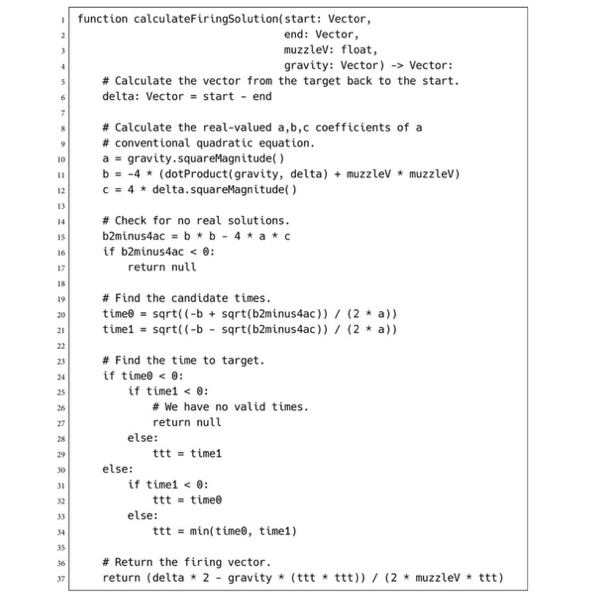
function calculateFiringSolution(start: Vector,
                                 end: Vector,
                                 muzzleV: float,
                                 gravity: Vector) -> Vector:

    # Calculate the vector from the target back to the start
    delta: Vector = start - end

    # Calculate the real-valued a, b, c coefficients of a quadratic
    a = gravity.squareMagnitude()
    b = -4 * (dotProduct(gravity, delta) + muzzleV * muzzleV)
    c = 4 * delta.squareMagnitude()

    # Check for no real solutions
    b2minus4ac = b*b - 4*a*c
    if b2minus4ac < 0:
        return null

    # Find the candidate times
    time  = sqrt((-b + sqrt(b2minus4ac)) / (2 * a))
    time1 = sqrt((-b - sqrt(b2minus4ac)) / (2 * a))

    # Determine the valid time to target
    if time < 0:
        if time1 < 0:
            return null
        else:
            ttt = time1
    else:
        if time1 < 0:
            ttt = time
        else:
            ttt = min(time, time1)

    # Return the firing vector
    return (delta * 2 - gravity * (ttt * ttt)) / (2 * muzzleV * ttt)
Explanation
This is the closed-form ballistic solution for hitting a static target with constant gravity.
Steps:
Compute displacement (Note: the pseudocode has it backwards)
[
\Delta = end - start
]
Solve a quadratic in (t^2) derived from projectile motion.
The two solutions correspond to:
high arc
low arc
Pick the smallest positive time.
Plug that time into the velocity equation to compute the launch direction vector.
The final vector is the normalized firing direction scaled by muzzle velocity.