




Intro
RGB (Red, Green, Blue) is an additive color model in which the red, green, and blue primary colors of light are added together to form different colors.
- Additive: colors mix by adding light → black = (0,0,0), white = (255,255,255)
- Secondary colors: Red + Green → Yellow, Green + Blue → Cyan, Blue + Red → Magenta
- “Useful for digital media because it directly corresponds to how screens display colors. Monitors and displays use tiny red, green, and blue pixels to create the colors you see” 1

A diagram demonstrating additive color with RGB
A color in the RGB model is created by combining varying intensities of red, green, and blue light. This is expressed as a triplet (R,G,B), in which each component channel is represented using an 8-bit integer value, ranging from 0 (no light/black) to 255 (full intensity/white).
Example:
(255, 0, 0)→ pure red(0, 255, 0)→ pure green(0, 0, 255)→ pure blue(255, 255, 255)→ white(0, 0, 0)→ black
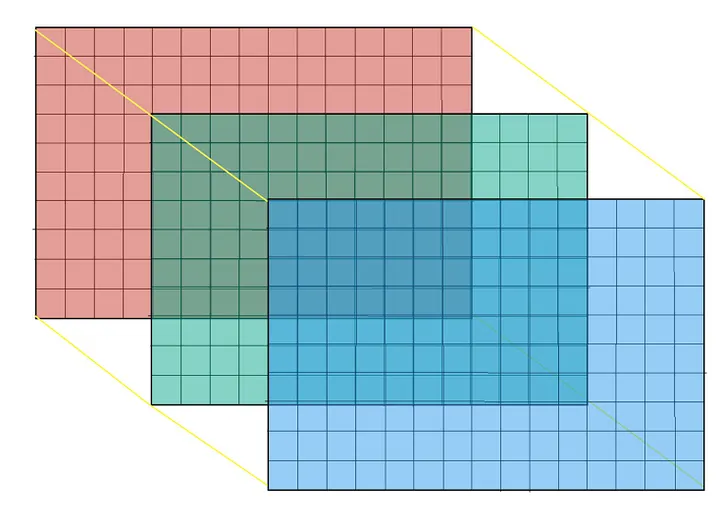
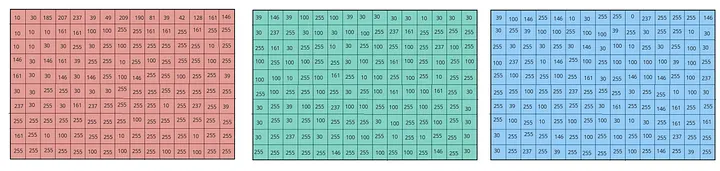
An additive model where colors are created by combining red, green, and blue light at different intensities. Each pixel holds three values — one for each color channel — ranging from 0 to 255.